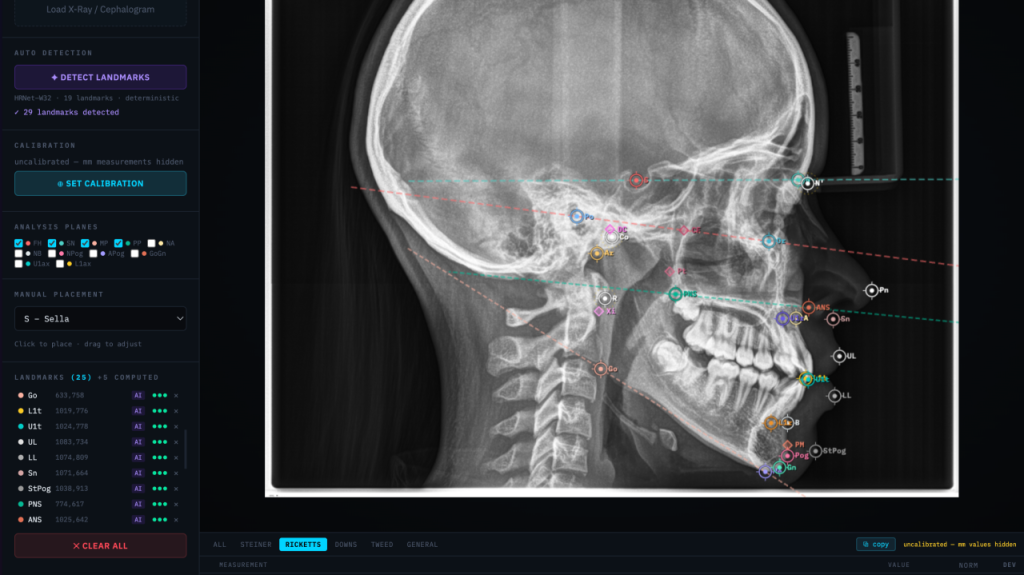
Three to four days. That’s how long it took me to go from zero knowledge of a specialized clinical domain to a production-grade diagnostic tool — one that achieves millimetric precision on medical imaging.
I’m not sharing that to impress you. I’m sharing it because I think most developers — and most companies — haven’t yet grasped what that kind of timeline actually means for what they can build, ship, and compete with right now.
AI has crossed a threshold. It’s no longer a neat productivity hack or a gimmicky autocomplete tool. It is a genuine force multiplier that is fundamentally changing what developers, teams, and entire organizations can realistically learn, build, and bring to market. The companies that internalize this are going to pull away from those that don’t — and the gap is compounding faster than most people realize. If you’re not feeling that yet, this is my attempt to show you what it looks like in practice.
A Passion Project Called Orion
For those who don’t know, Orion is my first real “baby” — a dental clinic management platform that I’ve poured years of work into. It’s something I’m genuinely proud of, and it has always been a reflection of my best thinking as a developer and technology leader.
As I began weaving AI into my own workflow, I also started exploring how it could improve the lives of the clinicians and patients that Orion serves. One particularly interesting challenge came up around treatment planning. For example, one of the most powerful things you can do for an orthodontic patient is show them projected results — give them a concrete, visual sense of what the end result will look like. It builds trust, creates stickiness, and gives patients a reason to stay committed to their treatment.
To do that at a professional level, orthodontists rely on a collection of tools; one of them being a cephalometric analysis: a method of measuring specific skeletal landmarks on a lateral X-ray of the skull to diagnose and plan treatment. Orion didn’t have this capability yet, and as an engineering leader who takes product completeness seriously, I knew that if I wanted to offer a truly comprehensive planning and assessment experience, I needed to build it.
Thinking Like an Engineer
My approach was strategic from the start: frame this as a computer vision problem, evaluate available tools, and determine the fastest path to a professional-grade solution. I began with OpenCV — a natural first candidate given its extensive image processing capabilities — exploring contour tracing and feature detection to identify skeletal landmarks on X-ray images.
I also evaluated whether general-purpose LLMs could handle raw image input directly. It was a reasonable hypothesis — if AI can analyze complex visual content, landmark detection on a structured medical image seemed feasible. The answer, as I validated quickly, was that general-purpose models aren’t optimized for the precision that clinical-grade cephalometric analysis demands. That was a fast and valuable data point, not a dead end.
The OpenCV route showed similar limitations. X-rays are unforgiving inputs — they vary widely in exposure, contrast, background noise, and vendor format. Rather than over-engineering a brittle solution, I made the architectural decision to look at how purpose-built tools in this space actually solve the problem. That’s good engineering: know when to build and when to find a better foundation.
What accelerated this entire evaluation process was having an AI partner to think through the problem space with me. Instead of spending days combing through research papers, I was able to rapidly surface relevant approaches and get to the right questions faster. I was compressing what could have been weeks of exploratory work into hours — and that’s the real force multiplier here.
Finding the Right Tool: HRNet
That research process led me to HRNet — a landmark recognition model developed by Microsoft Research and academic collaborators, specifically designed for high-resolution visual feature detection, with an existing implementation trained on cephalometric images. It was exactly the right foundation for the problem.
I deployed it as a self-hosted Python server — a deliberate architectural choice that kept the solution within our infrastructure rather than introducing an external API dependency — and the results were immediately compelling. Landmark detection was accurate, fast, and well within the precision range needed for clinical use.
Within a couple of hours, I had also built a UI that let a clinician load an X-ray, review the detected landmarks, and perform the full metric analysis. A capability that would have taken a specialized team significant time to deliver was taking shape in an afternoon — that’s what smart tool selection combined with AI-assisted development makes possible.
Pushing to Professional Grade: Training the Model
Shipping a working solution was only the beginning. Once I began testing against the full diversity of real clinical X-rays, it was clear the pretrained model had boundaries that wouldn’t hold up in a production environment with X-rays from different clinics, different equipment vendors, and varying exposure conditions.
Professional-grade cephalometric tools achieve millimetric precision. That was my target, and I wasn’t going to ship until we got there.
That’s when the real question crystallized: not “how do I fix this model?” but “what does this model actually need to achieve millimetric precision?” The answer broke down into three things — better quality training material, more and richer annotated datasets, and more relevant training transformations to build robustness into what was already a decent foundation. Once I understood the problem that way, the path forward was clear. It turns out there are publicly available, professionally annotated radiograph datasets purpose-built for exactly this problem. The resources were out there. I just had to know to look for them.
I expanded the training dataset using these public resources and fine-tuned the model accordingly. This brought an important ML engineering consideration to the forefront: catastrophic forgetting — the phenomenon where training a model sequentially on new data causes it to lose previously acquired knowledge, degrading its ability to generalize to unseen images outside the new training set. Managing that tradeoff carefully — through thoughtful dataset composition and training strategy — was key to achieving a model that was both accurate on new inputs and robust across the full range of clinical variation.
The result: a model that generalized well across diverse X-ray inputs and achieved the millimetric precision required for professional clinical use.
Total time from problem definition to production-ready tool: three to four days.
The Point of All This
I’m not sharing this story to brag — after all, any resourceful developer with the right amount of determination can do what I did. I’m sharing it because I think it illustrates something that a lot of people — a lot of companies — haven’t fully internalized yet: AI is no longer a gimmick.
It’s not a neat trick for autocompleting boilerplate or generating a SQL query you were too lazy to write. It is a genuine force multiplier that is changing what developers, teams, and organizations can realistically build and ship. The competitive gap between those leveraging AI and those that aren’t is growing every day — and it’s growing fast.
I went from zero knowledge of a specialized clinical domain to a production-grade diagnostic tool in three to four days. Not because I got lucky. Because I had a thinking partner that helped me ask better questions, move through the problem space faster, and access knowledge that would have otherwise taken weeks to accumulate. Now imagine that multiplied across an entire engineering team, an entire product organization.
That’s the part I want you to sit with. Not the tool I built — but what it means for what your team can build, and what your competitors are already building while you’re still on the fence.
If you’re a developer who has been treating AI as a curiosity on the side, I’d encourage you to flip that. If you’re a technology leader, the question isn’t whether AI belongs in your workflow — it’s how quickly you can make it central to how your team operates. Bring it into a real problem. A hard one. Something you’ve been putting off because it felt too far outside your expertise or too time-consuming to figure out. Use AI not as a shortcut, but as a collaborator — and pay close attention to what you’re learning in the process, because that compounds in ways that will surprise you.
The ceiling is gone. It’s time to find out how high you can go.
This is one story. I have many more just like it — each one a different problem, a different domain, the same result. I’ll keep sharing them.
Originally published on LinkedIn.

Recent Comments